- Workwiz
- Posts
- ✨ ChatGPT mastery made easy
✨ ChatGPT mastery made easy
Templates, prompting techniques, and more.

Before we get started (and it’s gonna be a good one), I have some exciting news.
I’m creating an online platform for professionals who want to unlock the full potential of ChatGPT & other AI tools to get more work done in less time.
It’s an all-in-one platform where you can find proven prompts, step-by-step guides, and the latest developments. Resources are updated daily and you can save your favorite resources to create your own AI tool kit tailored to your role.
Want free early access to the Workwiz platform?Bonus points if you leave more feedback after choosing an option👇 |
In today’s email:
ChatGPT Prompting Techniques: what techniques are there and how do you apply each technique?
AI Glossary: all the fancy AI words explained.
And an overview of the hottest AI tools of last week.

Prompting is hard, but the upside of a good prompt is worth the hassle.
To make good prompting easier I’ve created an overview of prompting tactics that are proven by scientific research and OpenAI.
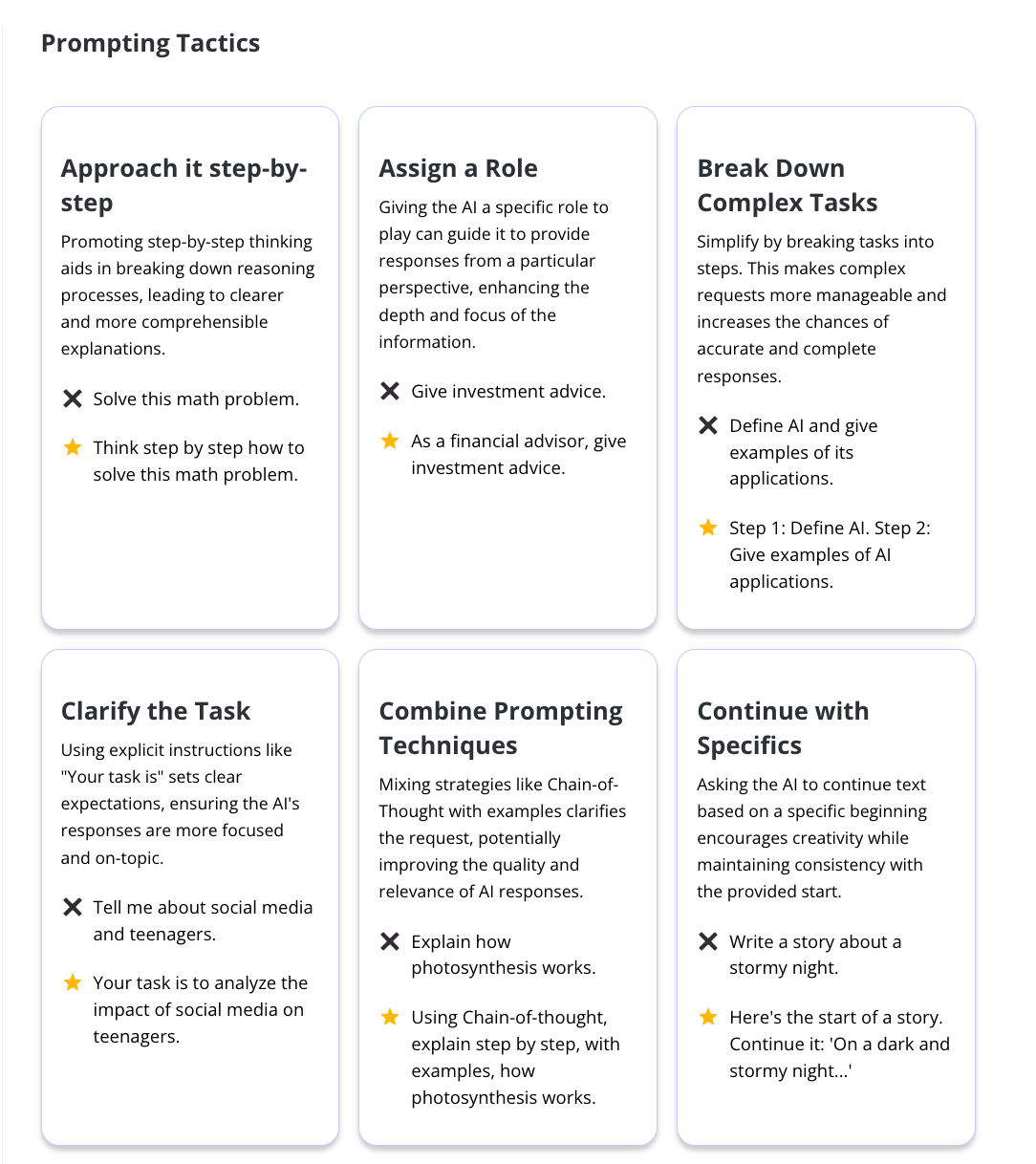
To give you an idea of how to apply these prompting tactics, let’s look at some examples.
For every prompt: be specific
The foundation of a good prompt is to be specific.
You need to have a clear idea of what you want. If you ramble some thoughts hoping it will create the perfect output then that will not happen.
If you spend more time thinking of your request then you will get to the perfect outcome faster.
Other tactics you can use are:
Give clear instructions on what the output should look like.
Break down complex tasks in multiple tasks.
Get straight to the point.
Use a prompting framework.
A good framework to follow is:
Instruction/Task: “Write a resignation email to my boss”
Context: “I’m leaving the company after 2 wonderful years. My boss can be a bit emotional so let him know it has nothing to do with him”.
Constraints: “Write it informal at a 5th grade reading level and don’t make it longer than 300 words”
Example (if relevant): “Replicate my writing style of this previous email I wrote: {email}”
When you want feedback
Asking for feedback or a second opinion is great way to use ChatGPT.
But ChatGPT is also programmed by default to be agreeable which can often result in sugar coated answers that are not constructive.
However, there are some tactics you can apply to get more honest feedback:
Be neutral and unbiased in what you would like feedback on—don’t present it as your idea but an idea.
Make it lists pros and cons to force it to look at all angles.
Ask it to be critical.
Working with complex scenarios
When you ask ChatGPT a question that is not straightforward but requires some thinking, then let it think by approaching it step by step also known as chain-of-thought prompting.
For example, riddles. And even though you probably don’t use ChatGPT to solve riddles, it’s a great example to illustrate why giving ‘time to think’ is important when dealing with complex questions.

It will not only give the right answer, it’s also a great way for you to learn how it’s approaching the scenario.
Want to learn all prompting techniques? Check out the resource below.

Sometimes technical words are required to not dilute the meaning of the context.
That’s why you can now find an AI glossary with the most common AI terms. And whenever I write about something I’ll highlight the word to reference it to the definition.
To get started, let’s look at some of the common words in the AI glossary.
LLM
Large Language Models (LLMs) are AI systems trained on huge datasets of text. They can understand and generate language in a way that mimics human writing.
ChatGPT is an example of an LLM, but so is Google’s Gemini, and Anthropic’s Claude.
Model
A model is a system that has been trained on data to recognize patterns and make predictions or generate content. If you are on the free version of ChatGPT then you use the GPT 3.5 model. The paid plan is on the GPT-4 model.
The differences in these models are substantial as GPT 3.5 is trained on about 175 billion parameters and GPT-4 over 1 trillion. These models are constantly improving and it’s rumored that GPT 4.5 will arrive soon.
AGI
AGI is the concept of a machine that can understand, learn, and apply knowledge in a way that matches or surpasses human intelligence. Unlike tools designed for specific tasks, AGI can theoretically handle any task a human can—and much better.
The goal of OpenAI (the makers of ChatGPT) is to achieve Artificial General Intelligence (AGI) that will benefit all of humanity.
Want to learn more AI definitions? Check out the glossary.

🛠️ New tools:
Giga🧠 - A search engine for real answers by real people.
Spoke - Slack app that provides a summarized overview of everything you missed after your holiday.
Sonia - AI cognitive Therapy (and a free Telegram version)
ElevenLabs Sounds - Create AI-generated audio effects for any project (coming soon).

What did you think of this email?
You can add more feedback after choosing an option, or you can reply to this email directly.
What did you think of today's newsletter? |
Enjoyed this newsletter? Forward it to a friend and have them sign up here.
See you next Thursday!
— Jerry